Hearing Loss and Dementia
Hearing loss can mimic nearly every early symptom of dementia, and standard memory tests can be failed by someone who simply cannot hear the questions. Check the hearing first.
Akriti Kumar, Audiologist
9 min read
Before you worry about memory loss, check the hearing first
A growing body of clinical evidence shows that hearing loss can mimic nearly every early symptom of cognitive decline. Millions of families are watching a parent or partner "forget things" — and missing what is often the real, treatable cause.
It starts with small things.
A parent who keeps asking you to repeat yourself.
A spouse who seems distracted in conversation. Someone who responds oddly in group settings and then apologises for "not being with it."
The family notices. The worry grows. Someone Googles "early signs of dementia." And a quiet, frightening narrative begins to take shape — one that may be missing something much simpler, much more treatable, and much more common than anyone in the room realises.
Hearing loss and early cognitive decline share a striking number of surface symptoms. Both can make a person seem confused, withdrawn, forgetful, and out of step with conversations around them. But one of these conditions is largely manageable with intervention. The other is not. Getting the distinction right matters enormously — for the person being assessed, and for the family making decisions around them.
A Scene Many Families Will Recognise
Dinner conversation. Five people at the table. Your father laughs at the wrong moment — responding to something that was said three sentences ago. He answers a question nobody asked. Later, when the table is cleared, someone says quietly: "Did you notice? He seems more confused lately."
Nobody considers that he may simply not have caught half of what was said — and filled the gaps as best he could.
This distinction — hearing loss masquerading as early memory loss — is one of the most underrecognised clinical mix-ups in ageing medicine. And in India, where both conditions carry significant social stigma and often go unaddressed for years, the consequences of getting it wrong are profound.
#1
Hearing loss is now the single largest modifiable risk factor for dementia from mid-life
2024 Lancet Commission
48%
Hearing intervention slowed cognitive decline in high-risk older adults over 3 years
ACHIEVE Trial, The Lancet 2023
7 yrs
Average time between noticing hearing difficulty and seeking any professional help
WHO Global Data
The symptoms are almost identical
Side by side, early hearing loss and early memory loss produce a list of behaviours that any family — and many doctors — struggle to distinguish without proper testing.
Hearing Loss
- Doesn't respond when called
- Asks people to repeat themselves
- Misses details in conversation
- Seems confused or "not following"
- Forgets what was discussed at meals
- Becomes withdrawn socially
- Turns the TV very loud
- Seems irritable or frustrated
- Struggles in group conversations
- Appears distracted or "elsewhere"
Early Memory Loss / Dementia
- Doesn't respond when called
- Asks people to repeat themselves
- Misses details in conversation
- Seems confused or disoriented
- Forgets what was discussed at meals
- Becomes withdrawn socially
- Has difficulty following media
- Seems irritable or frustrated
- Struggles in group settings
- Appears distracted or disconnected
10 out of 10 symptoms overlap
This is not a minor clinical nuance. It is a ten-symptom overlap between two conditions with completely different causes, treatment pathways, and outcomes. The diagnosis a family receives — dementia vs. hearing loss — determines everything that follows: the conversations they have, the decisions they make, the grief they carry, and the interventions they pursue or don't pursue.
The hidden trap in dementia screening
Standard cognitive screening tests can be failed by someone who simply can't hear the questions.
The MMSE — Mini Mental State Examination — is one of the most widely used cognitive screening tools in India and globally. It involves the clinician asking verbal questions. A patient with undiagnosed hearing loss who mishears a question will score lower — not because their memory is failing, but because their ears aren't delivering the full input. Yet in most GP clinics and many specialist settings in India, a hearing screen does not precede a cognitive screen. The result: hearing loss can artificially accelerate a dementia diagnosis.
Why hearing loss genuinely affects the brain
The relationship is not just a diagnostic overlap — it is biological. Hearing loss changes the brain through three documented mechanisms.
1. Cognitive Overload — The Brain Pays a Hidden Tax
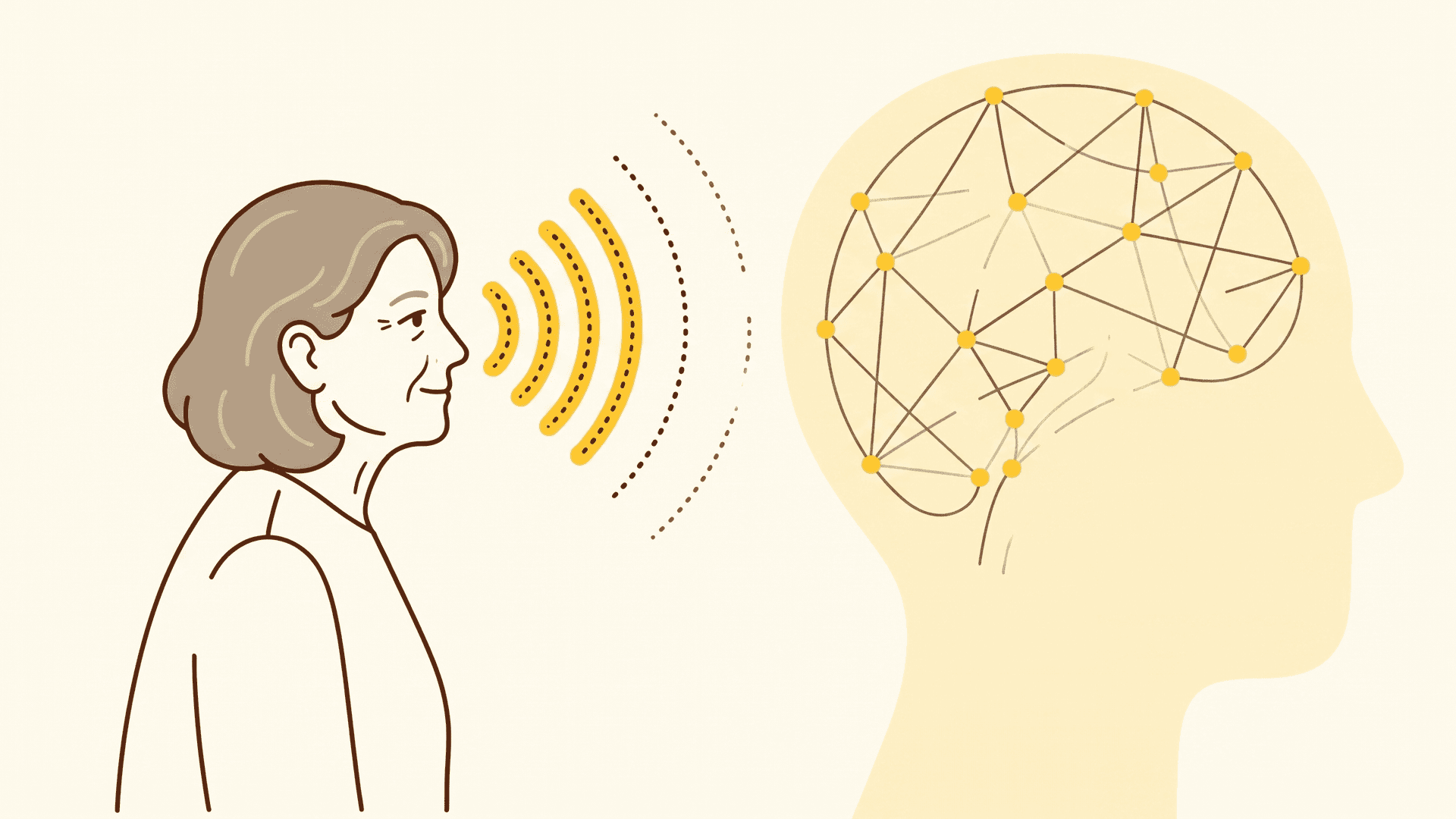
When the cochlea delivers degraded sound, the auditory cortex recruits additional cognitive resources to fill in the gaps — lip reading, context inference, pattern recognition, memory. This is the cognitive load hypothesis. Resources diverted to decode incomplete sound are no longer available for memory formation, reasoning, and executive function. Over years, this depletes what neuroscientists call cognitive reserve — the brain's buffer against decline. Hearing aids relieve this load, which is one mechanism by which they appear to protect cognition.
2. Brain Atrophy — Structures Actually Shrink
Hearing loss is associated with accelerated atrophy in the temporal lobe — the region handling auditory processing and memory formation. A landmark Johns Hopkins study linked hearing loss to greater rates of brain volume loss on MRI over time. Use it or lose it applies to neural circuits: when auditory input to a brain region is chronically reduced, the structural and functional integrity of that region declines. This is a biological consequence of the ears failing to feed the brain — distinct from the symptom overlap problem.
3. Social Isolation — The Invisible Accelerant
When hearing becomes difficult, the most natural response is withdrawal. Conversations become exhausting. Family gatherings become disorienting. The person retreats — and loses the most powerful modifiable protector of cognitive health: social engagement and mental stimulation. The 2024 Lancet Commission identifies social isolation as a significant independent risk factor for dementia. Hearing loss, untreated, creates it systematically — one avoided gathering at a time.
"The 2024 Lancet Commission identified hearing loss as the single largest modifiable risk factor for dementia from mid-life — above smoking, physical inactivity, hypertension, and depression."
Lancet Commission on Dementia Prevention, Intervention, and Care — 2024 Report
In India, both conditions are significantly underdiagnosed
India has an estimated 8.8 million people living with dementia — a number projected to nearly double by 2036. At the same time, hearing loss affects 63 million Indians, with most receiving no intervention for years, if ever.
The first nationally representative Indian data linking hearing loss to cognitive function came from the LASI-DAD study (2025) — the Longitudinal Aging Study in India — conducted by researchers from NYU, Johns Hopkins, USC, and AIIMS New Delhi. Using pure-tone audiometry on adults over 60, the study found a consistent association between hearing loss and lower scores across memory, executive function, language, and visuospatial domains.
What makes India's situation particularly acute is the compounding of two widespread gaps: late presentation for hearing concerns (most Indians wait years before seeing an audiologist, if ever) and limited dementia diagnostic capacity outside major cities. In this environment, hearing loss mimicking cognitive decline is almost guaranteed to be misread — because neither the GP nor the family is primed to ask about hearing before reaching for a cognitive diagnosis.
The Indian cultural context adds another layer. Dismissing an elderly parent's difficulty following conversation as "getting old" is deeply common. So is the quiet acceptance of social withdrawal in ageing relatives. These culturally normalised interpretations of hearing loss symptoms delay recognition — sometimes for a decade.
Treating hearing loss may genuinely protect the brain
For years, the dementia-hearing connection was correlational. Researchers could observe it but couldn't prove causation or show that treating hearing loss changed cognitive outcomes. That changed in 2023.
Landmark RCT — The Lancet, July 2023
The ACHIEVE Trial: The First Large-Scale Randomised Controlled Trial of Hearing Aids for Cognitive Decline
977 adults aged 70–84 with untreated mild to moderate hearing loss were randomised to either a hearing intervention (audiologist-fitted hearing aids plus counselling) or a health education control. They were followed for three years with regular cognitive testing.
48% Reduction in the rate of cognitive decline over 3 years, in adults at higher baseline risk
In older adults at increased risk for cognitive decline, hearing intervention slowed the loss of thinking and memory abilities by 48% over three years. Simultaneously, UK Biobank data (Jiang et al., 2023) showed no increased risk of dementia in people with hearing loss who were using hearing aids — suggesting the device acts as a protective intervention, not just a comfort measure.
This matters beyond the statistics: it means the brain is responding to restored auditory input. The cognitive decline associated with hearing loss is not fully inevitable. Some portion of it appears to be reversible — or preventable — with appropriate intervention. The audiologist, in this context, is not just fitting a device. They may be altering a cognitive trajectory.
How to begin to tell the difference
These are not diagnostic criteria — only a clinical assessment can provide those. But these patterns can help you ask the right questions before reaching for a conclusion.
Points to Hearing
Difficulty specifically in noisy environments - restaurants, family gatherings — but noticeably clearer one-on-one in quiet rooms.
Points to Memory
Forgets information even when it was clearly received and acknowledged — returning to the same question minutes later in a quiet, one-on-one setting.
Points to Hearing
Says "what?" or "pardon?" frequently, or misunderstands in predictable patterns — mishearing similar-sounding words, missing ends of sentences.
Points to Memory
Gets lost in familiar places, struggles with routine tasks, or shows changes in personality, judgment, or planning ability independent of conversation.
Points to Hearing
TV volume has increased significantly. Struggles specifically on phone calls — where visual cues are absent — but manages better face-to-face.
Points to Memory
Difficulty recognising familiar faces or places. Getting dates, seasons, or the year wrong. Disorientation that persists even in familiar, quiet environments.
Points to Hearing
Social withdrawal has increased, but motivation and engagement remain intact in quiet, one-on-one settings. The reluctance is about noise, not people.
Points to Memory
Significant mood or personality changes — apathy, suspicion, aggression — that go beyond frustration with communication difficulty.
The key pattern to recognise: if the difficulties are specifically worst in noisy environments, on phone calls, or in groups — and clearest in quiet, one-on-one settings — get a hearing test before anything else. It costs nothing, takes 30 minutes, and rules out the most treatable cause first.
The right sequence of steps
Start with a hearing evaluation
Before any cognitive assessment, get a pure-tone audiogram. It is non-invasive, takes 30 minutes, and definitively identifies whether hearing loss is contributing to the symptoms.
Ensure hearing is addressed before cognitive screening
If cognitive screening is required, tell the clinician about any hearing difficulties first. Proper cognitive testing must account for hearing status - otherwise results may be unreliable. Ask whether the screening tool accounts for hearing loss.
If hearing loss is found - treat it
The ACHIEVE trial evidence is clear: treating hearing loss in older adults at cognitive risk can slow decline. A correctly fitted hearing aid, programmed by a trained audiologist, is a clinical intervention with documented cognitive benefit - not just a comfort measure.
Track changes over time, not just in one visit
Both hearing loss and early memory changes are progressive. A baseline audiological assessment gives you a reference point. Changes become visible and measurable against it. Acting early on either condition produces better outcomes.
If you are a caregiver - bring the right questions
Ask the clinician: "Could this be hearing-related?" "Has a hearing test been done?" "Could the cognitive screening scores be affected by hearing difficulty?" These are reasonable clinical questions any audiologist or neurologist should welcome.
Both conditions can coexist — and must both be addressed
Hearing loss mimicking memory loss does not mean dementia is ruled out. The two frequently co-occur in older adults. Treating the hearing loss first - or simultaneously - improves communication, quality of life, and the accuracy of any ongoing cognitive assessment.
Rule Out the Most Treatable Cause First
If someone you love is showing signs of memory difficulty or cognitive change, a hearing evaluation is the most logical — and most overlooked — first step. At Synva, it takes 30 minutes, it is completely free, and it may change everything.
Confusion → Clarity. We're here when you're ready.
Share
WhatsApp