Debunking Common Ear Care Myths for Healthy Hearing
Ten ear care myths audiologists hear every week, from cotton buds to candle wax, and what the evidence actually says. Each myth comes with the fact and what to do instead.
Akriti Kumar, Audiologist
10 min read
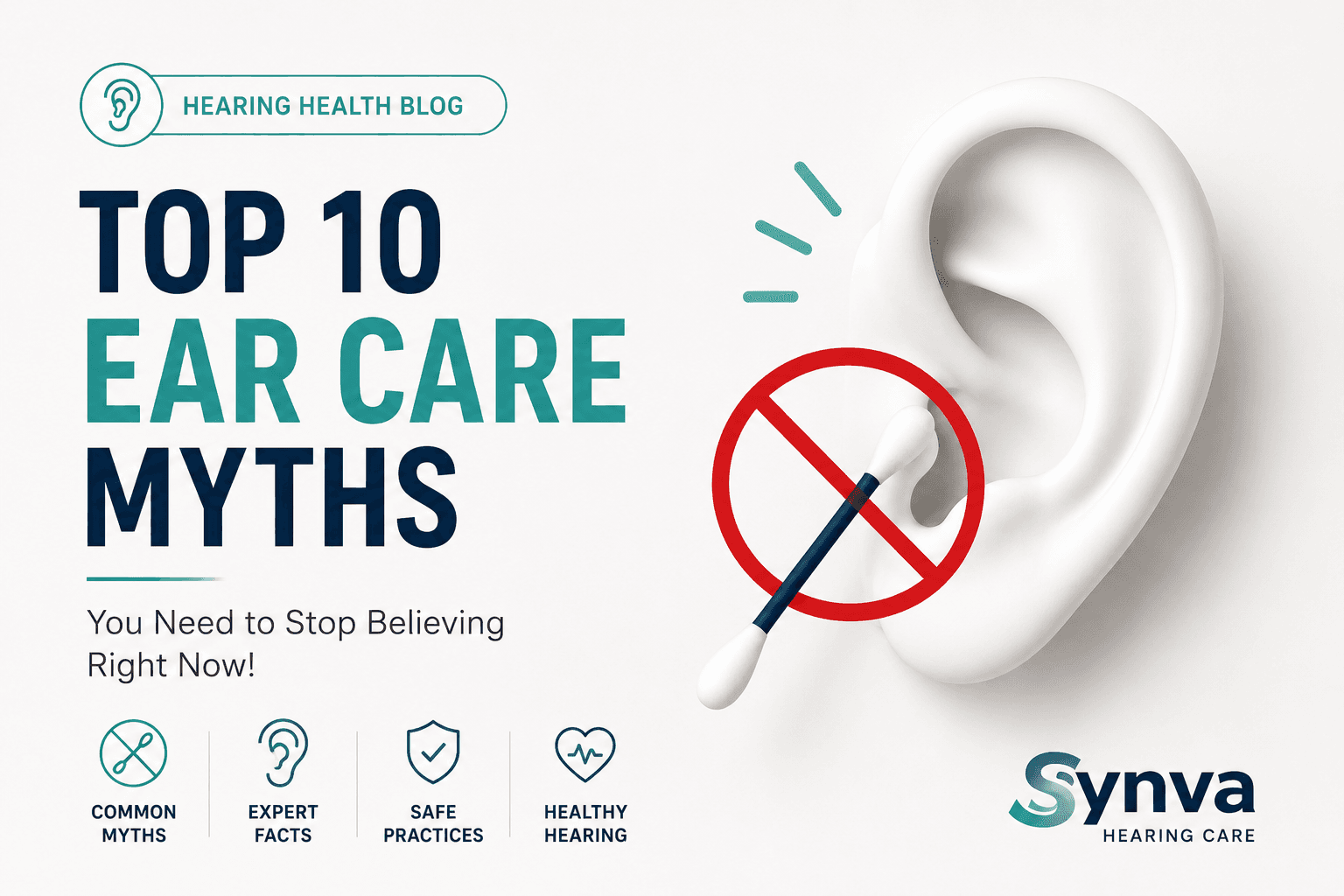
Top 10 Ear Care Myths
Let's be honest — most of us learned how to clean our ears by watching someone else do it. No instruction manual. No audiologist. Just habit, passed down like a family recipe.
The problem? Some of those habits are actively harming your ears. And a few of them — specifically the ones that feel the most satisfying — are the worst offenders.
At Synva, we see the damage every week. Impacted earwax pushed deeper by cotton buds. Ear canals irritated by oil. Eardrums at risk from practices that seemed perfectly reasonable. So here are 10 ear care myths that need to stop — one at a time, with the actual facts.
The ten myths
- Cotton Buds Are the Right Tool for Cleaning Your Ears
- Earwax Is Dirty and Should Be Removed Regularly
- Candle wax therapy removes ear wax safely
- Pouring Oil into ear cleans the canal and prevents infections
- Earphones and Ear Buds cause infection
- Loud music doesn't hurt your ears and hearing
- Swimming Always Leads to Ear Infections
- You Should Aggressively Dry Your Ears After Every Shower
- Hearing Loss only happen to old people
- Once You Have Hearing Loss, Nothing Can Be Done
Myth 01: Cotton Buds Are the Right Tool for Cleaning Your Ears
Cotton buds are one of the most common causes of ear canal injuries seen by audiologists and ENTs. The box itself says "do not insert into ear canal" — in the fine print that nobody reads. When you insert a cotton bud, instead of pulling earwax out, you push it further in. Wax compacts against the eardrum. Over time, this leads to impaction — a blockage that causes muffled hearing, pain, and ringing. In some cases, patients have perforated their eardrum.
70%+ of Indians clean inside their ear canal daily using cotton buds
What to do
- Clean only the outer ear — the visible pinna — with a soft, damp cloth
- The ear canal takes care of itself through epithelial migration (see Myth #2)
- If you feel blockage or reduced hearing, see an audiologist for professional microsuction — not a cotton bud
Myth 02: Earwax Is Dirty and Should Be Removed Regularly
Earwax — clinically called cerumen — is one of your body's most ingenious natural defences. It traps dust, debris, dead skin cells, and microorganisms before they reach the eardrum. It has antibacterial and antifungal properties. It keeps the ear canal lubricated and prevents the skin from drying and cracking. Your ears are also self-cleaning. Cells inside the ear canal migrate outward slowly — carrying wax with them — until it dries at the outer ear and flakes away naturally. Audiologists call this the epithelial migration process.
Over-cleaning strips this protective layer and paradoxically signals the body to produce even more wax.
What to do
- Unless you are experiencing symptoms — blocked hearing, discomfort, tinnitus, or visible buildup — your ears do not need cleaning
- Let the epithelial migration process do its job
- See an audiologist if you notice symptoms rather than attempting self-treatment
Myth 03: Candle wax therapy removes ear wax safely
Ear candling has been studied by researchers and consistently found to do exactly none of what it claims. A clinical study published in The Laryngoscope confirmed that ear candles create no measurable negative pressure or suction whatsoever. The wax that appears inside the burned candle is candle residue - not earwax pulled from your ear. What ear candling does produce: burns to the ear and face, candle wax dripping into the ear canal and creating new blockages, damage to the ear canal lining, and in some cases, perforated eardrums.
The U.S. FDA has issued explicit warnings against the practice.
What to do
- If you have significant earwax buildup, see an audiologist/ENT for professional microsuction — a safe, evidence-based procedure that takes minutes
- A traditional appearance does not make a practice safe or effective
- Never set your ear canals on fire. Period.
Myth 04: Pouring Oil into ear cleans the canal and prevents infections
This one requires nuance — because oil use is not entirely wrong, but how it is commonly practised often is. Warm olive oil or commercially prepared ear drops can help soften earwax before it naturally exits. Audiologists sometimes recommend this for mild wax buildup. This is clinically legitimate when done correctly. However: pouring any oil into an ear with an active infection, a perforated eardrum, or ear discharge is genuinely dangerous. Oil does not treat bacterial or fungal infections. It traps moisture, creates an environment for bacteria to thrive, and can worsen infection significantly. If the eardrum has a perforation — which is not always obvious — any liquid can pass into the middle ear, causing severe complications.
What to do
- If softening wax, use room-temperature commercially prepared ear drops — not cooking oils
- If you have ear pain, discharge, or any suspicion of infection — see an audiologist/ENT before introducing anything into your ear
- Never use oil that is too hot — you can burn the delicate ear canal skin
Myth 05: Earphones and Ear Buds cause infection
Earphones themselves do not directly cause ear infections — but the habits around them often do. In-ear earbuds create a warm, moist, low-airflow environment inside the ear canal when worn for long periods. This is a condition bacteria and fungi find hospitable. Most people never clean their earbuds, meaning they accumulate oils, dead skin, and microorganisms that get reintroduced into the ear every time you put them in. The problem is the habit, not the device itself.
Sharing earphones compounds the risk significantly — you are transferring another person's ear bacteria directly into your own canal.
What to do
- Wipe earbuds down with an antibacterial cloth after every use — especially after workouts
- Never share earphones with anyone
- Give your ears breaks of at least 30–60 minutes between extended listening sessions
- If you have an active ear infection, do not use in-ear earbuds until it has fully healed
Myth 06: Loud music doesn't hurt your ears and hearing
This is one of the most dangerous myths on this list, because noise-induced hearing loss is painless, cumulative, and permanent. The ~16,000 hair cells inside your cochlea that convert sound into signals your brain recognises — called stereocilia — do not regenerate. Once damaged, they are gone forever. And they begin to suffer damage not when sound becomes painful, but when it consistently exceeds 85 decibels for extended periods. Normal conversation ≈ 60 dB. Maximum earphone volume on most smartphones ≈ 100–110 dB. By the time you perceive hearing difficulty, a significant portion of those hair cells is already gone — permanently.
1B+ young people globally at risk of noise-induced hearing loss from unsafe listening
What to do
- Follow the 60/60 rule — 60% maximum volume for no longer than 60 minutes at a stretch
- Use noise-cancelling headphones to avoid raising volume in noisy environments
- Get a hearing test annually if you are a regular earphone user
Myth 07: Swimming Always Leads to Ear Infections
Swimming itself does not cause ear infections. The conditions around swimming sometimes do — specifically, water remaining trapped in the ear canal after a swim, creating moisture that bacteria can thrive in. This is called otitis externa — commonly known as swimmer's ear — and it is preventable, not inevitable. The risk increases with contaminated or stagnant water, existing ear infections, or inadequate drying afterward.
What to do
- After swimming, tilt your head to each side and let water drain naturally
- Dry the outer ear gently with a soft towel — do not insert anything
- If you swim frequently and are prone to infections, use swim-specific earplugs
- Most people have no reason to avoid swimming entirely
Myth 08: You Should Aggressively Dry Your Ears After Every Shower
A small amount of water entering the outer ear canal during a shower is entirely normal and harmless. The ear's self-cleaning mechanism handles it without any intervention. Aggressively poking towels, tissues, or cotton buds into the ear canal to chase out water is far more likely to cause damage than the water itself — scratching the delicate canal skin, disrupting the cerumen layer, and introducing new bacteria from your hands or towel surface.
What to do
- Tilt your head gently after a shower and let water drain naturally
- A hair dryer on the lowest, coolest setting held about 30 cm from the ear can gently encourage evaporation
- That is genuinely all you need
Myth 09: Hearing Loss only happen to old people
Age-related hearing loss — called presbycusis — does exist. But hearing loss does not discriminate by age. According to the WHO, over 1 billion people aged 12 to 35 years are at risk of hearing loss due to noise exposure alone. In India, audiologists are seeing a significant rise in hearing concerns among people in their 20s and 30s — driven by heavy earphone use, occupational noise, untreated childhood infections, and a widespread reluctance to get tested until problems become severe.
7+ yrs - The average time a person waits between noticing hearing difficulty and seeking help
That is 7 years of the brain adjusting to degraded input — making rehabilitation harder when they finally do come in.
What to do
- Get a baseline hearing test in your 20s or 30s — there is no age threshold
- If you use earphones regularly, work in loud environments, or have a family history of hearing loss — get tested now
- A hearing test is simple, painless, and takes 30 minutes
Myth 10: Once You Have Hearing Loss, Nothing Can Be Done
This myth stops more people from getting help than almost any other — and it needs to be put to rest clearly. Most sensorineural hearing loss cannot be medically reversed. That part is true. But it absolutely can be managed, and the difference between unmanaged and well-managed hearing loss is life-changing. Modern hearing aids do not simply amplify sound. They use AI processing to separate speech from background noise, adapt automatically to different environments, stream directly from phones and televisions, and dramatically reduce the cognitive exhaustion that comes from straining to hear. With a correctly fitted device, most people with sensorineural hearing loss can return to full social participation. The key phrase is correctly fitted. A poorly programmed hearing aid underperforms badly — which is why many people who've tried hearing aids gave up on them. The device was not the problem. The fitting was.
What to do
- If you or a family member has been putting off an evaluation because "nothing can be done anyway" — book the check-up this week
- Insist on a properly fitted, clinician-programmed hearing aid — not an over-the-counter device
- The difference between doing nothing and getting the right solution is not small. It is profound.
The common thread
Every single myth on this list involves someone doing something to their ears without a professional assessment first.
Whether it is reaching for a cotton bud, trying an oil remedy, or deciding that hearing loss is just part of getting older — the decision is made without the one tool that actually matters: your audiogram. Your ears are individual. Your hearing profile, ear canal shape, wax production pattern, and hearing loss type are unique to you. What works for one person may be exactly the wrong thing for another. That is not a reason to be anxious — it is a reason to ask someone who knows.
When Should You See an Audiologist? You do not need a GP referral to see an audiologist in India. You can book directly. Here are the signs worth acting on.
🔇
Muffled or reduced hearing
That does not clear on its own after a day or two — especially if it appeared suddenly.
👂
Fullness or blockage sensation
Feeling like your ears are "full" or plugged — with or without hearing change.
🔔
Tinnitus (ringing or buzzing)
Any persistent ringing, buzzing, hissing, or humming that others cannot hear.
😣
Ear pain or discomfort
Particularly if accompanied by discharge, fever, or a recent upper respiratory infection.
🗣️
Difficulty during conversations
Especially in noisy environments, group settings, or on phone calls — where visual cues are reduced.
📺
TV volume creep
Gradually turning the volume up over months — often noticed by family before the person themselves.
😵
Listening fatigue
Feeling unusually tired after conversations or meetings — a sign the brain is working harder to decode sound.
💧
Discharge from the ear
Any fluid — clear, yellow, or bloody — coming from the ear canal requires prompt professional assessment.
Get Your Hearing Checked at Synva
We offer full audiological assessments — completely free — at our Hearing Experience Centre in Kachiguda, Hyderabad.
No pressure. No upselling. Just a clear picture of where your hearing stands and an honest conversation about what, if anything, to do about it.
Confusion → Clarity. We're here when you're ready.
Share
WhatsApp