
Stop WASTING your MONEY when buying Hearing Aids | Follow This 3-Step Framework
Synva’s three step framework for buying hearing aids without wasting money: match the type to your hearing loss, match features to your lifestyle, then decide with your budget.
Akriti Kumar, Audiologist
4 min read
Choosing a hearing aid today can feel overwhelming. With so many models in the market and every clinic suggesting something different, it’s easy to get confused.
Let’s be honest, most people end up either buying the wrong model or overpaying for features they don’t really need. Why does this happen?
Because most hearing care professionals (HCPs) either:
- Recommend based on what they want to sell more, or
- Don’t have a scientific framework to guide you in choosing the best option.
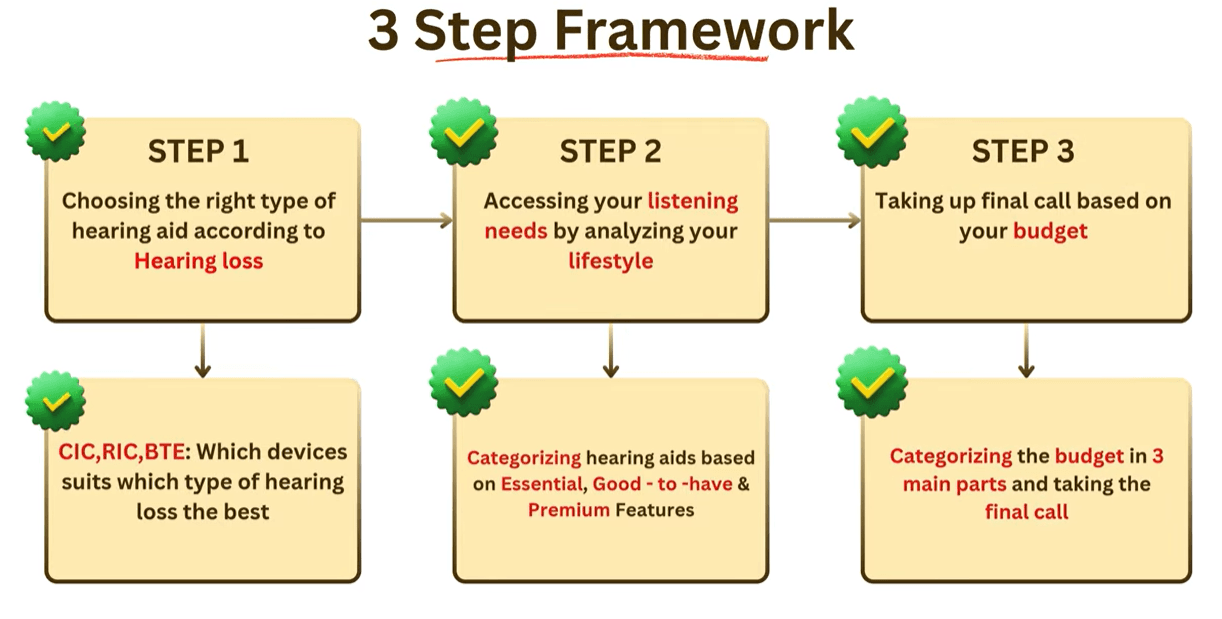
But here’s the good news, Synva's Founder, Mr Chintan Bhayani, alongside his team has tried, tested and refined a simple 3-step framework that has helped over 500+ people to buy the right hearing aid — one that fits their hearing needs, lifestyle, and budget perfectly.
And in this post, we’ll walk you through the same method so you can do it too.
Step 1: Choose the TYPE of Hearing Aid According to Your HEARING LOSS
Not all hearing aids are built the same, and they definitely aren’t one-size-fits-all.
Each type of hearing aid (like BTE, RIC, CIC, or ITE) has a different power capacity and amplification range. That’s why the first step is to match your hearing loss with the right type of device.
For better understanding, lets see some examples:
- If you have mild to moderate loss (around 40–60 dB), a small invisible model like CIC or IIC may be perfect.
- And if you have severe loss (around 75–90 dB), you’ll need a more powerful device, such as a RIC or BTE model.
The goal is simple - Choose the type of hearing aid that provides enough amplification for your degree of hearing loss, without compromising comfort or aesthetics.
(To understand - which type of hearing aid is suitable for your hearing levels, please watch the video at the top of this page - https://www.youtube.com/watch?v=b6Djs7FB2Nc)
Step 2: Assess Your Lifestyle and Listening Needs
Once you’ve identified the right type of hearing aid, the next step is to match it with your lifestyle.
Let’s understand this with an example :

Mr. Rakesh, 45, is a working professional who attends meetings, travels, and often socializes in noisy places.

Mr. Srinivas, 75, is retired, enjoys his morning walks, and spends most of his day at home watching TV.
Their lifestyles and listening environments are completely different.
So their hearing aid needs are also different:
- Mr. Rakesh needs features like advanced noise reduction, adaptive microphone directionality, and dynamic sound processing to help him hear clearly in meetings or parties.
- Mr. Srinivas might do perfectly well with a basic programmable device that handles TV and conversation clarity indoors.
Your daily routine, age, and listening environments play a huge role in choosing the right model.
There are at least 8–10 hearing aid features that matter depending on your lifestyle — from Bluetooth connectivity and rechargeability to speech clarity in noise. We shall deep dive into these features in this series.
Step 3: Take a Final Call Based on Your Budget
Now comes the last step — your budget. And here’s where most people make a mistake.
There are two types of buyers we usually meet:
Type 1 : “Budget-First” Thinkers
They decide beforehand that they’ll only spend ₹30,000 or ₹50,000 and pick the best they can get in that range.
Type 2 : “Needs-First” Thinkers
They first shortlist the most suitable models based on their hearing loss and lifestyle, and then choose the one that fits their budget best.
The smart approach? Combine both.
First, shortlist your options scientifically (with steps 1 & 2), and then categorize them like this:
Category | Typical Price Range (per pair) | What You Get |
|---|---|---|
Essential | ₹25,000–₹35,000 | Basic programmable devices for mild loss |
Good-to-Have | ₹50,000–₹70,000 | Rechargeable models with basic noise cancellation |
Premium | ₹1,00,000–₹5,00,000 | Advanced features like adaptive microphone directionality, dynamic sound processing, and superior speech clarity in noise |
Remember: You don’t always need the most expensive device, but you do need one that matches your needs perfectly.
The right hearing aid is the one that helps you:
- Prevent further hearing loss
- Hear speech clearly in different environments
- And stay within your comfort budget
In Summary
When you choose your hearing aid using this 3-step scientific framework, you’re not just buying a device —you’re investing in a better hearing experience, tailored to you.
The 3-Step Framework
- Match your Hearing Loss with the right type of device
- Align with your Lifestyle and listening needs
- Balance it with your Budget
This is just the first post in our “How to Choose the Right Hearing Aid” series. In the next blogs, we’ll break down each step in detail, with examples and model suggestions for every type of need.
Share
WhatsApp